

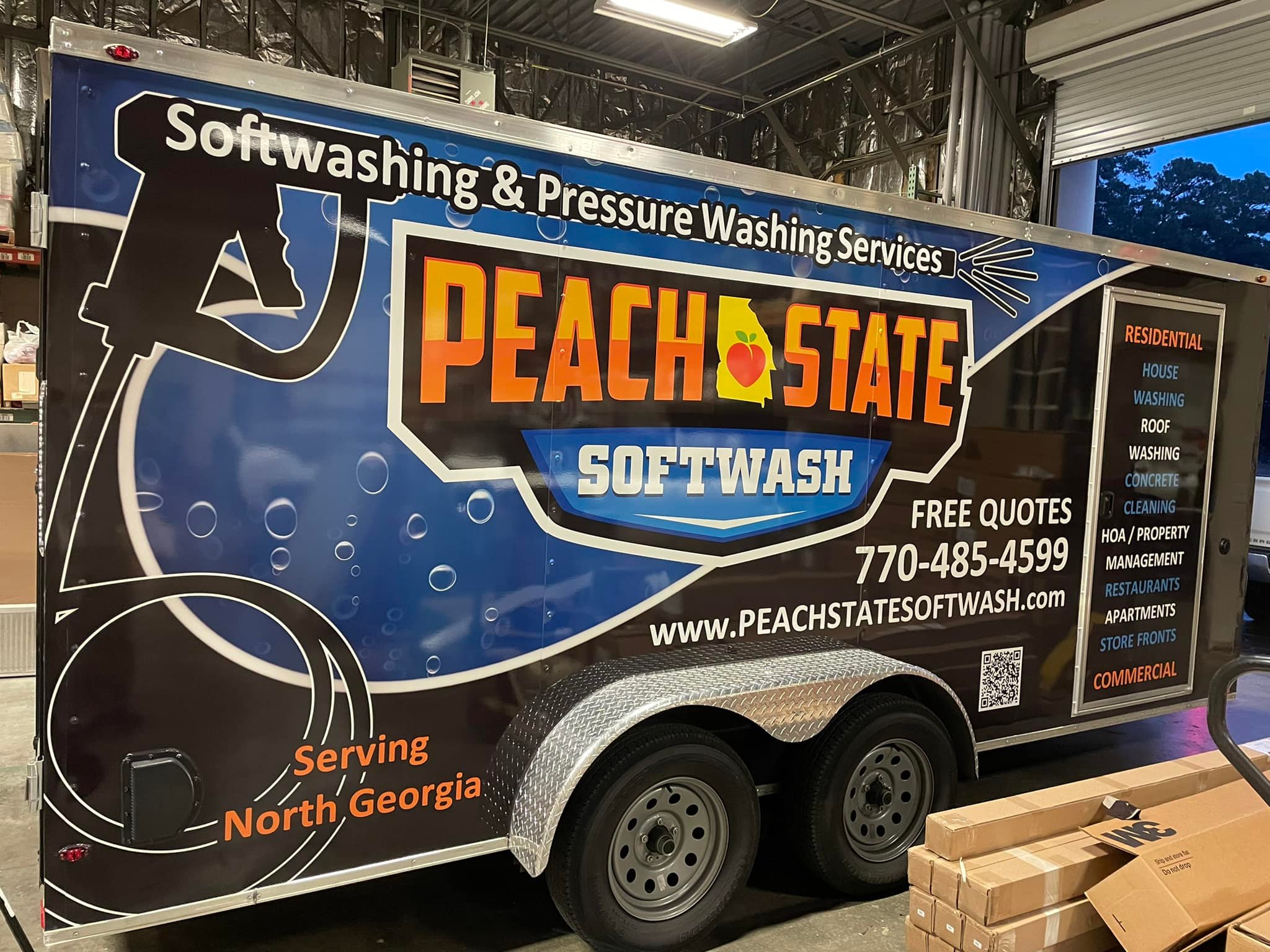
The Biggest Billboard You Own Is Already Driving I-285
If your company runs semi-trailers through Atlanta, you already own the largest advertising surface most businesses will ever touch. A 53-foot trailer presents a flat side roughly the size of a highway billboard, and it spends its life on the most congested interstate loop in the Southeast. Wrapped, it works for you every mile. Bare, it is just white steel telling the world nothing.
We wrap trailers for fleets running freight, moving, and distribution routes across metro Atlanta, and the appeal is simple math. A billboard on I-75 reaches the cars near that billboard. A wrapped trailer reaches I-75, then the warehouse district near Fulton Industrial, then a customer's loading dock in Marietta, then back down the Connector the next morning.
A Trailer Is Not Just a Big Van
People assume a trailer wrap is a car wrap scaled up. The surface tells a different story. Most dry van trailers are not smooth; they are built from corrugated panels with deep vertical ribs, plus rivets, seams, and rub rails running across the side. Vinyl has to be worked into and over all of that.
That texture is the defining challenge. Graphics have to be laid out so the important content sits where it can be read cleanly, and so logos and faces do not fall across a hard rib line that distorts them. An experienced layout accounts for the corrugation from the start instead of fighting it after the fact.
Smooth-sided trailers, which use a flat composite skin instead of ribbed panels, give you a cleaner canvas closer to a box truck. They cost more as equipment, but they hold detailed graphics with less compromise. Knowing which type of trailer you are wrapping changes the whole design conversation.
Designing for a Driver Doing 65
The audience for a trailer wrap is almost always moving, and so is the trailer. That means the design has to communicate in the few seconds someone spends alongside it in traffic. The name of the company, what it does, and one way to act on it should be legible from several lanes over.
We push hard against the instinct to cram a trailer full of services, certifications, and phone numbers. On a surface this big the temptation is to fill it, but a clean layout with a dominant brand element and breathing room reads from a distance. The corrugation already adds visual noise; the design should subtract it.
Placement also has to respect the hardware. The landing gear, the rear doors, the rub rails, and any reflective tape or DOT markings required on the trailer are fixed points the artwork has to work around. We design with those in place rather than discovering them at install.
Full Wrap, Partial Wrap, or Just the Doors
Not every trailer needs full coverage to do its job. A full wrap turns all three visible sides into a unified brand statement and makes the strongest impression, which suits fleets where the trailer is the public face of the company.
A partial wrap concentrates graphics on the high-impact zones, often the rear third of the side and the back doors, over a painted or factory-finished base. It is a way to get a strong presence on more trailers for a given budget. Even rear-door-only graphics earn their place, because the back of your trailer is what every driver stuck behind it at a light on Northside Drive stares at.
The right answer depends on how the fleet runs and where the trailers spend their time. Trailers that sit at a busy yard visible from the road get different treatment than ones that live on long-haul lanes.
Built to Survive Georgia Miles
Trailers take a beating. Road grime, sun, washes, and the constant flex of highway travel all work against a wrap. Cast vinyl with a quality laminate is built to handle that environment, and good surface prep before install is what keeps the graphics down through years of service.
Reality check: trailers also get scraped at docks and clipped by yard equipment. One advantage of vinyl over paint is that a damaged section of a wrap can often be addressed without redoing the whole trailer, which keeps a banged-up panel from taking the entire brand down with it.
Practical Takeaways
Before wrapping a trailer, know whether it is corrugated or smooth-sided, because that decides how much detail the design can carry. Keep the layout simple enough to read at highway speed, design around the trailer's hardware and required markings, and match the coverage level to how the fleet actually runs.
We wrap trailers and full fleets for businesses moving freight through Atlanta every day. If you have steel sitting on I-285 doing nothing for your brand, bring us the trailer specs and we will help you turn those 53 feet into the hardest-working billboard you own.
Ready to Get Started?
Contact Extreme Color today for vehicle wraps, signs, banners, and more.
Get a Free Quote