
The First Ten Feet Decide Everything
A trade show floor is one of the most competitive visual environments in business. Hundreds of booths within walking distance of one another, attendees moving fast, decisions about who to engage made in the time it takes to walk past. The first ten feet of approach to any booth is where the decision happens. Either the visual sells the next interaction, or the attendee keeps walking. There is no second chance on a show floor.
We've printed booth graphics for Atlanta businesses showing at the Georgia World Congress Center, AmericasMart, the Cobb Galleria, and conferences around the country. The clients who win at trade shows aren't necessarily the ones with the biggest budgets or the most floor space. They're the ones who treat the booth like a piece of design that has a specific job — pulling the right people in from a distance, telling them what the company does in two seconds, and making the next step obvious.
What the Booth Is Actually Doing
The mistake we see most often is treating the booth like a brochure. Brochures get unfolded in someone's hands at close range. Booths get scanned from across a hallway by people who haven't decided whether to stop. Those are completely different design problems with completely different solutions.
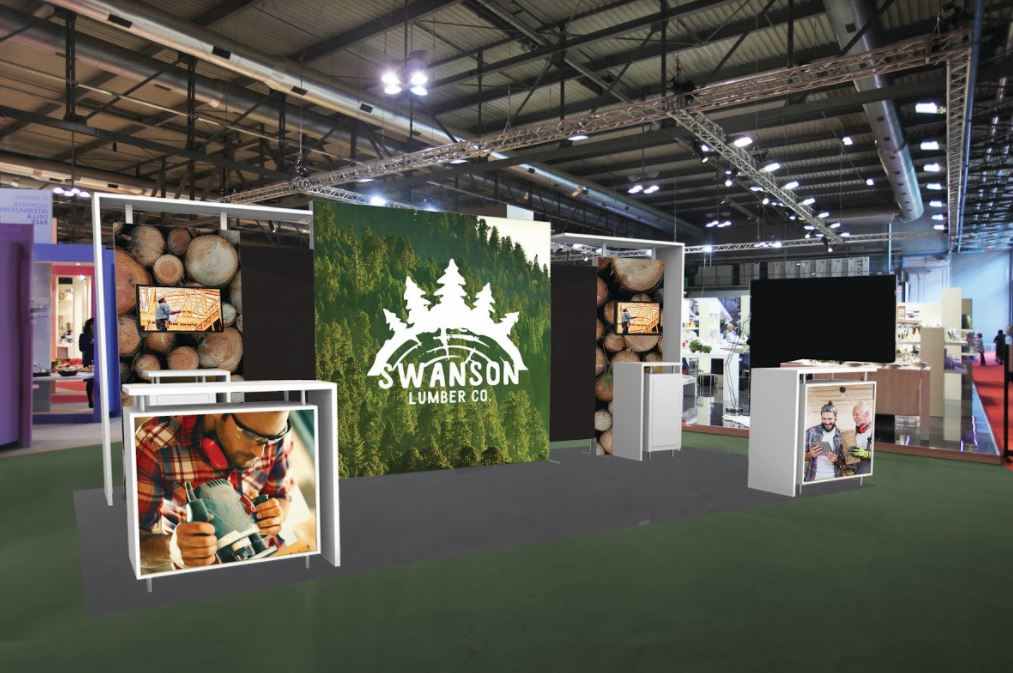
The header — the top portion of the back wall visible above the crowd — has to communicate one thing: who you are and what you do. Big, legible, readable from fifty feet. The body of the booth, at conversation distance, can support more detail. The closing area, where someone is already engaged, can carry the longer story. Most failed booths reverse this — fine print at the top, branding at the bottom, the actual hook nowhere visible from the aisle.
The Print Formats That Make Up a Booth
A standard trade show booth pulls from a small toolbox of print formats, each doing a specific job. Tension-fabric backdrops give you a clean, wrinkle-free wall in widths from 8 feet up to full booth walls 20 feet or wider. They pack down small, ship inexpensively, and set up in minutes — a major advantage when you're flying graphics to a show in another city.
Retractable banner stands sit on the corners or alongside the booth, holding secondary messaging at standing height. Hanging banners, suspended from the show's truss system above the booth, are visible from across the entire hall and give larger exhibitors aisle dominance that nothing else does. Counter wraps turn the booth's check-in counter into a branded surface. Floor graphics direct foot traffic into the booth. Each format has a role.
Materials That Survive the Show Cycle
Trade show graphics get rolled up, packed in cases, shipped via freight, set up by tired people, broken down on tight deadlines, and shipped again. Materials that look great in a portfolio but tear at the grommets after two installs aren't materials we use. The tension-fabric we print on holds wrinkles flat after rough handling, washes clean if it gets stepped on, and reads vibrantly under typical convention center lighting which is rarely as good as it should be.
Rigid graphics — foam board, PVC, aluminum composite — get used for elements that need to stay perfectly flat or hold up to physical contact. Counter wraps, podium graphics, product display boards. We match the substrate to the abuse it'll take and the budget the show calls for. A graphic that goes to one show needs different specs than one that needs to last a year of monthly events.
Designing for the Convention Center, Not Your Office
The lighting on a show floor is unflattering by design — overhead fluorescent or LED at intensities that wash out subtle colors and make low-contrast text disappear. Designs that look gorgeous on a designer's monitor sometimes turn to mush under convention center light. Our team checks proofs in conditions closer to what the booth will actually live under, not just under the daylight-balanced LEDs in our shop.
Color matching matters here in a way it doesn't matter for most projects. A national brand wants its red to look the same in Atlanta as it does in Chicago, Las Vegas, and Orlando. We work with Pantone color matching on booth graphics specifically because the same brand will be visible next to a competitor's booth in a head-to-head comparison, and "close enough" isn't close enough.
Modular Systems for Companies That Do Multiple Shows
For clients running a circuit of shows — and we work with several Atlanta-based companies that do five or six a year — the smart move is a modular system. Standardized hardware, interchangeable graphic panels, configurations that scale from a 10×10 booth at a small regional show to a 20×30 island at a major industry conference. The graphics get reprinted as messaging evolves, but the underlying frame and structural pieces last for years.
This is where the economics get interesting. A single custom build for one show is expensive. A modular system amortized over a year of shows is dramatically cheaper per appearance, and the company shows up looking more consistent everywhere it appears. We've helped several Atlanta clients build out modular kits that travel from Las Vegas to Orlando to a regional show at the Cobb Galleria without any element looking out of place.
The Pre-Show Timeline That Saves the Day
If a trade show is on your calendar, the timeline that makes us nervous is anything under three weeks. The work itself we can produce quickly. The decisions about messaging, design, and configuration are the part that always takes longer than people think. Coming in early with a clear show brief — booth dimensions, the goal of the show, the audience attending, the one thing you most need them to remember — moves the project from "we'll figure it out" to "here's a system that will win you the show floor."
The other timeline benefit of coming in early is logistics. Show freight, drayage, and shipping all have deadlines that creep up faster than expected. A booth that arrives at the show in good shape and on time has already beaten a meaningful chunk of competitors who are still chasing their crates the morning of opening day.
What to Bring Us to Start
Booth dimensions, the floor plan if you have it, the show's graphics specs if the organizer has published them, your brand guidelines, and a clear sentence describing what success at this specific show looks like. With those five things, our team can walk you through what the booth should look like, what it'll cost to print and ship, and what timeline gets you to the show floor with everything in good shape.
Ready to Get Started?
Contact Extreme Color today for vehicle wraps, signs, banners, and more.
Get a Free Quote