
The Camera Sees Everything
Production design lives and dies on detail. A scene set in 1978 falls apart the moment a viewer spots a logo that didn't exist yet, a font that was redesigned in 2003, or a vinyl banner hanging where a hand-painted sign should be. We've worked on enough Georgia productions to know that period accuracy isn't a nice-to-have — it's the difference between a believable world and a Reddit thread picking your show apart frame by frame.
Atlanta has become one of the busiest film markets in the country, and we've spent years helping productions across the metro turn ordinary locations into convincing backdrops for any era. That work usually starts with print.
What Period-Accurate Print Actually Means
It's not just "old-looking signs." Period accuracy is research-driven. The typefaces, color palettes, materials, weathering, mounting hardware, and even the way print fades over time all change by decade. A 1950s diner sign and a 1980s diner sign use different inks, different paper stocks, and entirely different visual languages.
When we get a call from a production designer, the conversation usually starts with: what year, what city, what economic context, and what kind of business? A struggling Midtown laundromat in 1973 doesn't look like a flagship Buckhead boutique in 1973 — the print quality alone tells you which is which.
Reproduction Storefront Signage
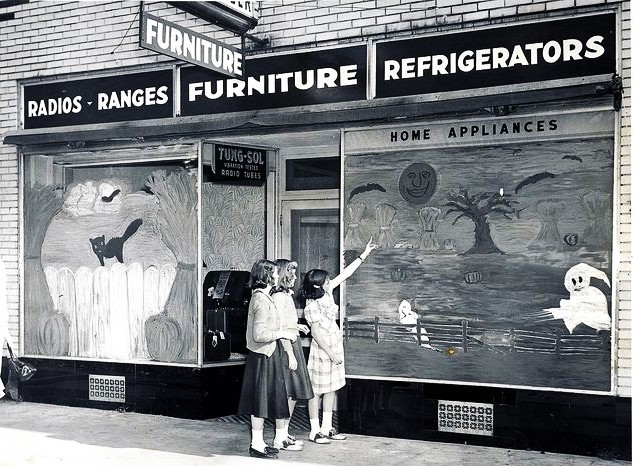
Most of the work we do for productions is exterior storefront print. We've recreated mid-century awning bands, hand-lettered window signs from the 1960s, fluorescent-era plastic letter face boards, and 1990s vinyl banners that look like they've been hanging through a decade of Georgia summers.
The materials matter. A reproduction sign printed on modern, smooth substrate reads "new" on camera no matter how distressed it looks. We choose stocks, finishes, and laminations that match the era — and we age them when the script calls for it. Heat, sun, scuffing, and selective wear all sell the lie.
Window Graphics, Painted Looks, and Hand-Lettered Signs
A surprising amount of period work happens on glass. Old storefronts almost always had something painted on the windows — hours, specials, dry-cleaning prices, beauty parlor pricing, watch repair turnaround. We reproduce those hand-painted looks in cut vinyl or printed translucent film, then apply them so the camera can't tell the difference from across the street.
For productions shooting in working businesses on the BeltLine, in Cabbagetown, or along the old industrial blocks in West End, we install temporary period graphics that come down clean at the end of the shoot day. No residue, no damage to the real business's windows.
Period-Accurate Posters, Flyers, and Set Dressing
Inside the storefront, the print never stops. Concert posters on a coffee shop wall, missing-pet flyers on a corkboard, sale signs taped to a register, brochures fanned across a counter — every one is an opportunity for the camera to find an anachronism. We print these as set-dressing batches, often dozens of variations so the art department can layer them.
Productions shooting period Atlanta want flyers for businesses that existed then, music acts that toured then, products that were sold then. We work from references the art department provides and produce the print accordingly.
Working Around a Tight Shoot Schedule
Production timelines are unforgiving. Locations get locked late, scripts get rewritten the night before, and the art department often needs a stack of period signage on short notice. We're set up to handle that pace. Most of our production work moves directly from a designer's reference photos to print to set, and we deliver to locations across metro Atlanta — from soundstages in Doraville and the studio lots out east to neighborhood shoots in Inman Park and East Point.
What helps is having all the production steps in one shop. Printing, cutting, mounting, laminating, and applying the work ourselves means fewer handoffs and a faster turnaround.
Aging, Distressing, and Selling the Wear
A pristine reproduction sign is the giveaway. Period storefronts were exposed to weather, smoke, hands, paint touch-ups, and decades of business. We finish a lot of pieces with controlled wear — corner scuffs, edge fade, water staining, faux paint chips, hand-rubbed grime around handles. Done right, a reproduction sign should look like it has a history.
For close-up hero pieces, we'll sometimes go further: hand-distressing edges, layering paint over print, or building dimensional pieces that look hand-carved instead of printed.
What Productions Should Ask Before Print Begins
Two questions tighten the whole job. First, what's the actual camera distance? A sign that will only be seen from across the street can be printed and finished very differently from one that's a foreground hero in a 50mm close-up. Second, will the sign live outdoors for the shoot? Georgia weather in summer is brutal on print materials, and a sign that has to survive three weeks of rotating shoot days needs to be built tougher than a one-day piece.
Productions that bring those answers early save real money and time in the print stage.
How to Start
If you're a production designer, set decorator, or art coordinator working on a period project in Atlanta, the earliest a print shop gets involved, the cleaner the result. Even a rough reference deck and a list of locations is enough for us to start scoping materials and timelines. The more we know about the era, the budget, and the camera angle, the more we can do to make the print invisible — which, on a period set, is exactly the point.
Ready to Get Started?
Contact Extreme Color today for vehicle wraps, signs, banners, and more.
Get a Free Quote