
A Food Truck Is Two Things at Once
It's a kitchen and a billboard, and the billboard side has to work harder. A food truck has maybe ten seconds to convince someone walking past at a festival, a brewery, or a corporate lunch park that the line is worth standing in. The wrap is doing the convincing, and a lot of trucks we see around Atlanta are leaving easy customers on the sidewalk.
We wrap a lot of mobile kitchens — taquerias, BBQ rigs, dessert trailers, coffee carts, and full-size step vans built out into commercial galleys. Food truck wraps are some of our favorite projects because the design constraints are tight, the surface is small, and the result has to read at five feet and fifty feet.
Why Vinyl, Not Paint
A food truck owner could paint the vehicle. They almost never should. Paint is slow, expensive, and permanent. Vinyl wraps print at photographic quality, install in days instead of weeks, and come off cleanly when the menu changes or the truck gets sold. For a business that might rebrand twice in five years, that flexibility matters.
Vinyl also takes details paint can't. Photographic food shots, gradients, textures, hand-lettered logos, intricate illustrations — they all print to a wrap and stay sharp. Paint is great for solid colors and graphic shapes. Wraps are great when the brand needs storytelling.
The Hierarchy of Information
Most food truck wraps fail because they try to say everything at once. The cuisine, the truck name, the slogan, the social handles, the website, the phone number, the menu items, the awards — all crammed onto the same panel.
The truck has three reads. The first read, from across a festival or parking lot, should communicate exactly one thing: what kind of food. That's a single bold image or word. Tacos. Burgers. Pho. The brain decides whether to walk over in under two seconds, and the wrap has to win that second.
The second read, from the line, is the brand personality. Logo, color palette, illustration style, anything that makes someone glad they chose this truck instead of the one parked next to it. The third read, at the window, is the practical information — menu, prices, social, ordering.
Designing for the Truck's Actual Shape
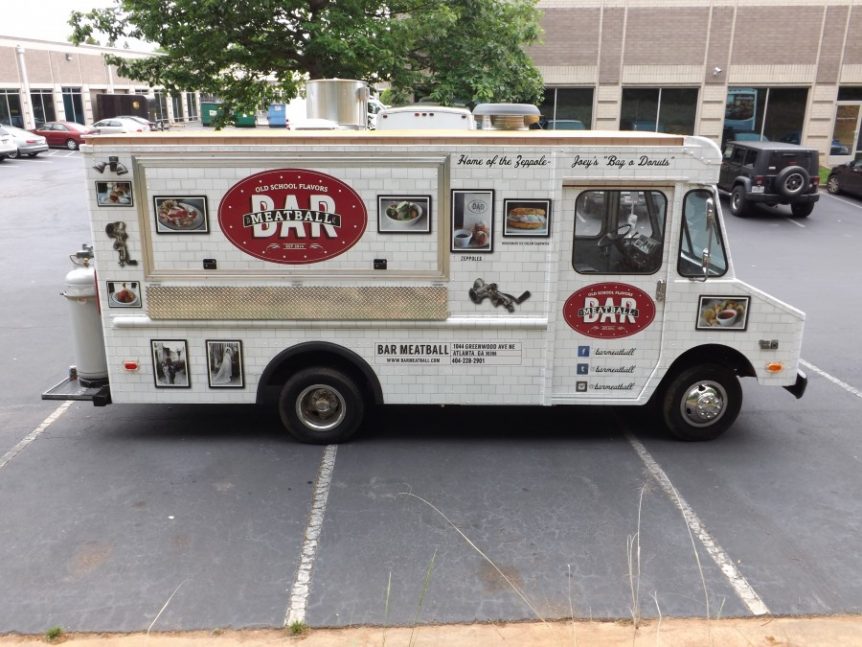
Trucks aren't billboards. They have hoods, fender wells, doors, service windows, propane tanks, fuel doors, and serving counters. A wrap design that ignores the physical truck reads as a sticker slapped on a kitchen.
We always start with photos of the actual vehicle from every angle, then design around the cutouts, hinges, and seams. A great wrap uses the truck's shape. The service window becomes a frame for the menu. A wheel well becomes part of the illustration. A propane door disappears into a background pattern instead of interrupting a logo.
Photography and Illustration
If you're selling food, the food has to look great on the wrap. That usually means professional photography, not phone snapshots. We've worked with food truck owners across Atlanta who tried to use Instagram shots on their wrap and ended up with grainy, color-shifted images blown up to wall size. It looks worse the bigger it gets.
Illustration is often the smarter move for food trucks. A stylized illustration of the signature dish carries the brand better than a photo, scales beautifully, and doesn't lock the brand into one menu item. We've done painted-style taco illustrations, line-art ice cream cones, and full-mural-style scenes that turn the truck into a moving piece of art.
Atlanta Operating Realities
A food truck in Atlanta lives a hard life. Summer heat in the parking lot during a festival on the BeltLine. Long afternoons at brewery yards in the Westside and Old Fourth Ward. Power-washing weekly. Stone chips from rolling between gigs in Marietta, Decatur, and Stone Mountain. The wrap material has to handle all of that.
We use cast vinyl for food trucks, not calendered. Cast wraps conform better to curves, hold color longer under UV exposure, and stand up to the constant cleaning a food truck requires. The lamination on top is the part that actually takes the abuse — grease, soap, scrubbing, and sun — so it has to be a quality clear film.
Service Window, Back Doors, and Operator Side
The service side of the truck is where the customer experience happens. Menu boards, pricing, mobile ordering QR codes, and any required permits live here. We design the service-side wrap with this in mind: clean negative space around the window for menu changes, a permitting panel that doesn't fight the brand, and clear sightlines for the people working inside.
The opposite side of the truck — the operator side, away from the customer line — is often forgotten. We treat it as a billboard for people passing the parked truck or for cars driving alongside on the highway when the truck is on the move. Bold logo, bold flavor, big phone or social.
What to Bring to a Food Truck Wrap Conversation
The shorter the brief, the longer the project. The food trucks that move fastest through our shop bring three things: a clear sense of the cuisine and brand personality, the vehicle's exact make and model with current photos, and any existing logo files in vector format. From there, we can scope a design and put real options in front of the owner instead of guessing.
If a food truck owner is starting from scratch — new business, no logo, no brand — that's fine too. We can either build the brand in-house or coordinate with the owner's designer to make sure the print and vehicle work together.
The Goal: Stop the Crowd
A great food truck wrap stops the crowd. It makes the line longer at every festival, builds a recognizable brand customers chase from gig to gig, and turns the truck itself into the strongest piece of marketing the business owns. For Atlanta operators trying to stand out in a crowded mobile food scene, the wrap isn't decoration — it's the front door.
Ready to Get Started?
Contact Extreme Color today for vehicle wraps, signs, banners, and more.
Get a Free Quote