
The Wall Nobody Knows What to Do With
Every Atlanta office buildout, every hotel renovation, every restaurant fit-out has the same conversation at some point. There is one big wall — the one behind reception, the one in the elevator lobby, the back wall of the main dining room — and nobody knows what to do with it. Paint feels like a missed opportunity. Hanging artwork is expensive and dated quickly. A commissioned mural costs five figures and takes weeks.
The answer that most designers and facilities managers are landing on is custom printed wallcoverings. Our wide-format shop produces these constantly for Atlanta clients, and the technology has come far enough that there is essentially no design constraint left. If it can be designed, we can print it on the wall.
What Custom Wallcoverings Actually Are
Modern custom wallcoverings are printed on a specialized vinyl or non-woven substrate using wide-format inkjet printers. The substrate goes up like wallpaper, with a smooth-pasted application that bonds to a properly prepped wall. The print can be photographic, graphic, illustrative, typographic, or anything in between, and it can span entire walls at full resolution without visible seams from normal viewing distance.
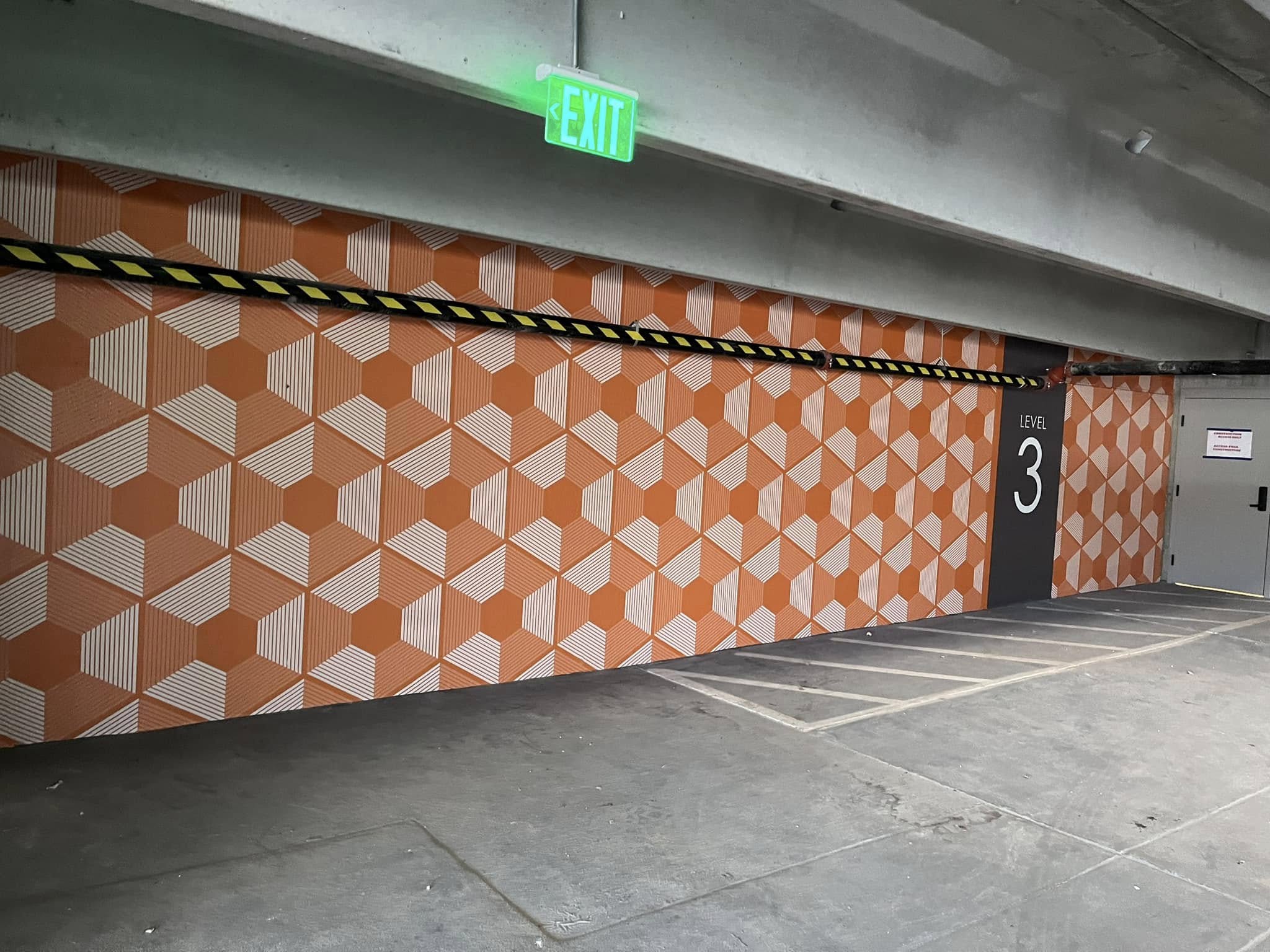
The applications we see most often in Atlanta fall into three buckets. Branded environments, where a company prints its visual identity, mission language, or product imagery at architectural scale. Atmospheric environments, where the goal is to set a mood rather than display a brand. And wayfinding environments, where the wallcovering is doing navigational or informational work as well as decorative.
Office Lobbies and Reception Walls
The reception wall is the single highest-impact print surface in a corporate office. Every visitor sees it before they see anything else, and the wall sets the tone for whatever meeting follows. We have printed reception wallcoverings for law firms in Buckhead, tech companies in Tech Square, agencies in West Midtown, and corporate headquarters out in Sandy Springs and Alpharetta.
The designs vary wildly. Some clients want their full logo at scale, treated as architectural typography. Others want a subtle pattern derived from their brand mark, repeating across the wall as texture. Others want a photographic image — a city skyline, a product hero shot, an abstract macro of their materials — turned into a mural-scale statement.
What unites the successful installs is that the design treats the wall as architecture, not as a poster. The graphic has to live with the lighting, the furniture, and the foot traffic for years, so the design choices that work are the ones that hold up at multiple distances and in different light.
Conference Rooms and Collaboration Spaces
The interior walls of conference rooms and collaboration spaces are another strong wallcovering opportunity, and one that often gets underused. A conference room with a custom wallcovering on the long wall reads as intentional. The same room with a single piece of framed art reads as generic.
For collaboration zones, we have printed wallcoverings that include the company's values, product roadmaps, customer logos, or even wayfinding maps of large campuses. These installs do real cultural work. Employees notice them, visitors comment on them, and they end up in the photos that get shared on social and in recruiting materials.
Hospitality and Restaurant Applications
Hotels and restaurants have been ahead of the corporate world on wallcoverings for a decade, and the technology has caught up with the ambition. We have produced wallcoverings for Atlanta boutique hotels that include hand-illustrated city scenes, for restaurants that wanted the back wall of the dining room to become an immersive landscape, and for bars that needed a single dramatic wall to become the photographable backdrop the brand was built around.
Hospitality clients tend to push the design further than corporate clients, which is part of what makes these projects fun. We have printed wallcoverings with metallic inks, with textured finishes, and with deliberate distress patterns that make the print look like it has been there for a hundred years.
The Substrate Choices That Matter
Not all wallcoverings are the same, and matching the substrate to the environment is one of the most important calls we make on a project. The variables are durability, finish, removability, and budget.
For high-traffic commercial environments — lobbies, hallways, restaurants — we use commercial-grade vinyl wallcoverings with a wear layer that resists scuffing and can be wiped clean. These hold up to brushes against luggage, chair backs, and the general abuse of daily use.
For office environments that need to be removable when the lease ends, we use non-woven substrates designed for clean removal. These come off without damaging drywall and let the tenant change the design when the brand evolves.
For specialty applications — moisture-prone spaces, textured walls, exterior-adjacent installations — we have specialty films that solve the specific environmental problem at hand. Part of our job is matching the right substrate to the right wall.
Installation: The Step Most People Underestimate
A great wallcovering print can be undone by a bad install, and a great install can save a mediocre print. The wall preparation is critical. New drywall needs the right primer. Existing painted walls need to be cleaned and assessed for adhesion. Imperfections in the wall surface will telegraph through the print, so plaster repair often happens before the wallcovering goes up.
Our installation team handles wallcoverings as a specialty install, not as an afterthought. The panels have to be aligned, the seams have to disappear at normal viewing distance, and the corners and edges have to be cut clean. For complex installs with multiple walls, doorways, or architectural features, we will often do a site survey before printing to make sure the artwork is laid out around the obstacles correctly.
How a Project Usually Comes Together
A typical custom wallcovering project starts with a site visit. We measure the wall, assess the substrate, take photos, and talk through the design intent with the client or the designer. From there, the design either comes from the client's team, from a designer they are working with, or in some cases from our in-house team.
Once the artwork is finalized, we proof the print at scale before producing the full run. This step matters. A color that looks right on a screen can shift on a wall under retail lighting, and a small proof on the actual substrate is the cheapest way to catch that before the install.
After production, we schedule the install around the client's operating hours. For commercial lobbies and restaurants, this usually means evenings or weekends so the space is back in service the next morning. For office buildouts during construction, we coordinate with the general contractor to fit our install into the finish schedule.
What Print Can Do That Paint Cannot
Paint is the default for empty walls because it is cheap and familiar. But paint cannot tell a story, cannot carry brand language, cannot turn a corridor into a memorable moment. Custom wallcoverings can do all of that, at a price point that compares favorably with commissioned art once the wall scale gets large enough.
If there is a wall in your Atlanta office, lobby, or hospitality space that everyone agrees should be doing more, our team can usually walk through the substrate, design, and install considerations in a single conversation. The wall is going to be there either way. It might as well be working for you.
Ready to Get Started?
Contact Extreme Color today for vehicle wraps, signs, banners, and more.
Get a Free Quote